2026 · Clément Loyer
Aerothermodynamic Analysis of Hypersonic Reentry Vehicles: Implementation and validation of an ablation module in the NSMB solver
EPFL Master Project in Fluid Mechanics, 2026.
Context
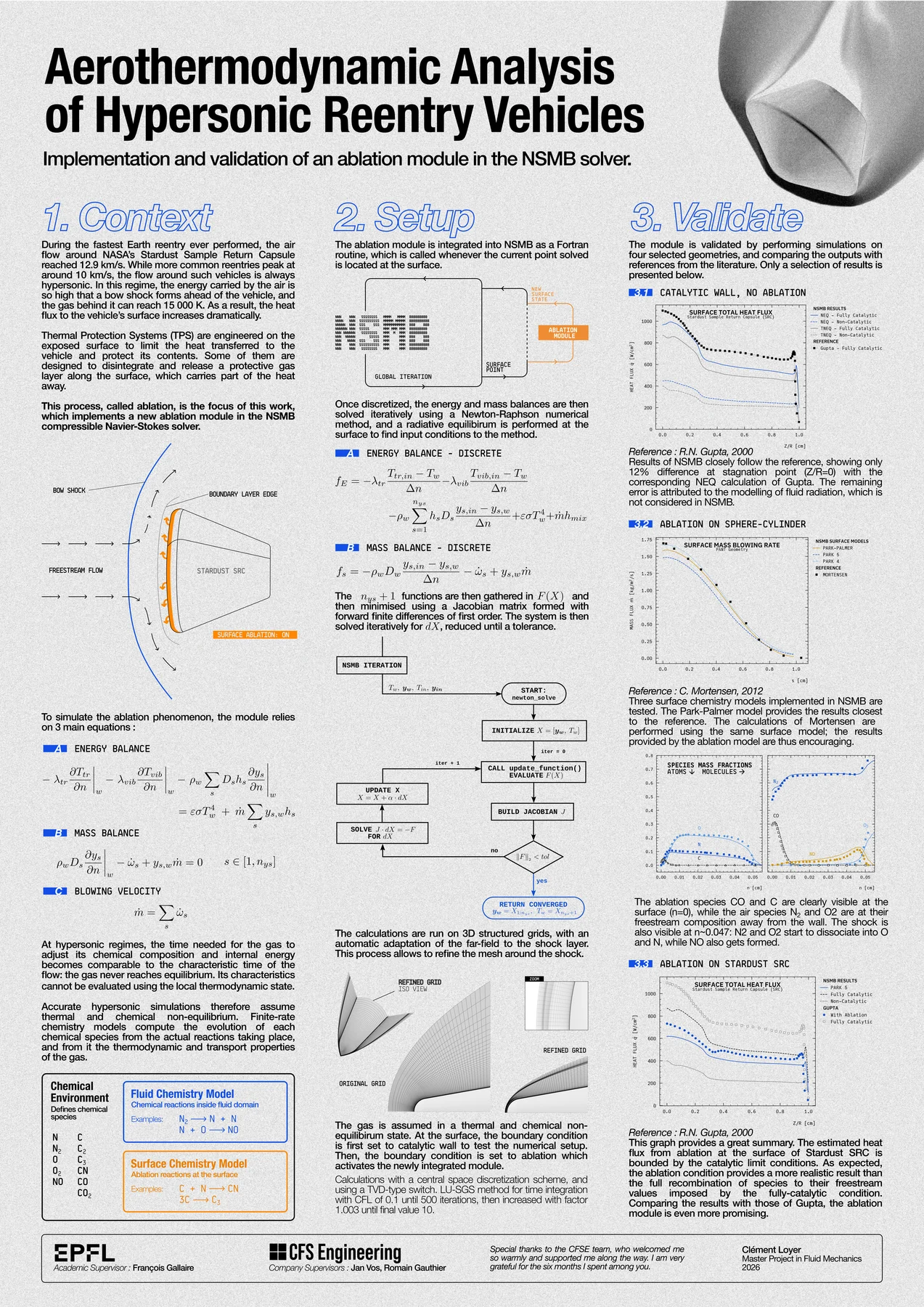
During the fastest Earth re-entry recorded, airflow around NASA’s Stardust Sample Return Capsule reached 12.9 km/s. At hypersonic speeds, a bow shock forms ahead of the vehicle and the gas behind it can reach 15,000 K, dramatically increasing heat flux to the surface.
Thermal protection systems limit heat transfer to the vehicle. Some are designed to disintegrate and release a protective gas layer that carries heat away. This process, called ablation, is the focus of this work, which implements a new ablation module in the NSMB compressible Navier–Stokes solver.
At hypersonic conditions, gas composition and internal energy can change on timescales comparable to the flow, so the gas may not reach equilibrium. Accurate simulations therefore use thermal and chemical non-equilibrium models that compute species reactions and derive thermodynamic and transport properties.
Setup
The module is integrated into NSMB as a Fortran routine called when the current solution point is at the surface. It solves discretised energy and mass balances iteratively with a Newton–Raphson method, with radiative equilibrium at the surface used to determine input conditions.
The calculations use three main relations: an energy balance, a mass balance, and blowing velocity. The resulting nonlinear system is minimised with a Jacobian formed from first-order forward finite differences and solved iteratively to a tolerance.
The calculations run on three-dimensional structured grids with automatic far-field adaptation to the shock layer. This refines the mesh around the shock. The poster compares catalytic-wall and ablation boundary conditions and describes a central-space discretisation scheme, a TVD-type switch, and LU-SGS time integration.
Validation
For a catalytic wall without ablation, NSMB results closely follow the reference of R. N. Gupta (2000), with a 12% difference at the stagnation point for the corresponding non-equilibrium calculation. The poster attributes the remaining error to fluid-radiation modelling, which is not included in NSMB.
For a sphere-cylinder case, three surface-chemistry models are compared with C. Mortensen (2012). The Park–Palmer model gives the closest results to the reference.
For the Stardust capsule, the ablation heat flux lies between catalytic-limit conditions and is more realistic than the fully catalytic condition. Comparison with Gupta’s results supports the ablation module. The poster also shows ablation species at the surface and air species away from the wall, with shock-layer dissociation and NO formation.