NSMB technical overview
Specific physics, resolved in motion
Three NSMB capabilities shown through focused cases: smart shock adaptation, dynamic-stability analysis, and Chimera grids for unsteady moving bodies.
[01]
Shock adaptation
Smart far-field shock adaptation concentrates the available resolution around a moving shock without adding cells to the domain. The result is a more efficient mesh and a better predicted heat flux on the geometry's surface.
- Approach
- Far-field adaptation
- Mesh cost
- No added cells
[02]
Dynamic stability
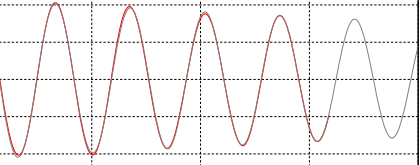
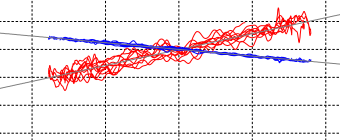
A free-pitching penetrator system at Mach 0.9 is perturbed through a 15° oscillation. NSMB resolves the transient flow and extracts the aerodynamic histories needed to determine whether disturbances are damped or amplified.
- Case
- M = 0.9 penetrator
- Motion
- Free pitch · 15° amplitude
[03]
Chimera & unsteady motion
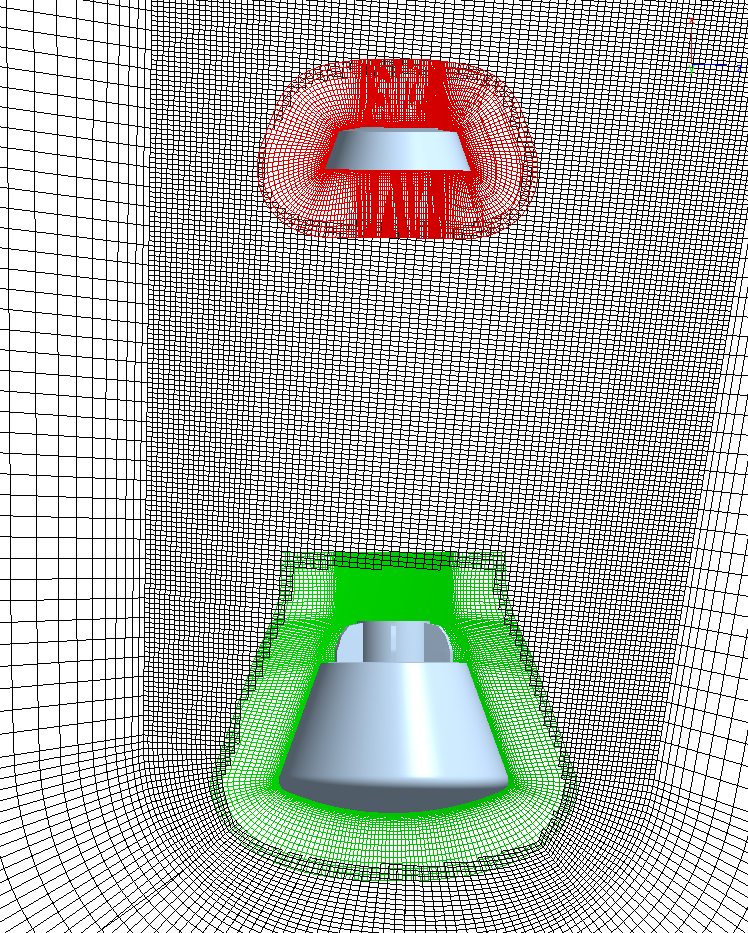
The Chimera, or overset-grid, method lets each part of a moving configuration keep its own structured mesh. Overlapping grids exchange the flow through interpolation, making complex motion and changing body relationships practical to simulate.
Here, independent grids around a capsule and its apex cover move through a background grid while the unsteady flow field evolves around them.
- Grid strategy
- Overset / Chimera
- Application
- Moving-body separation