Engineering service
Aerodynamics — CFD services
Aerodynamics is the science of how objects move through air. Accurate prediction of lift, drag, stability, and turbulent flow helps create safer, more efficient aircraft and vehicles.
Analysis approach and scope
RANS and DES methods can be used across the regimes described below. Accuracy depends on the geometry, mesh, boundary conditions, turbulence model, and available validation data; the appropriate method and limits are agreed for each case.
Typical outputs
- Aerodynamic coefficients and load distributions for agreed conditions
- Static or dynamic stability results and flow-field evidence
- A documented comparison against available wind-tunnel, flight, or reference data
Related publications
Lift and drag prediction
This device is using the lightweight preview.
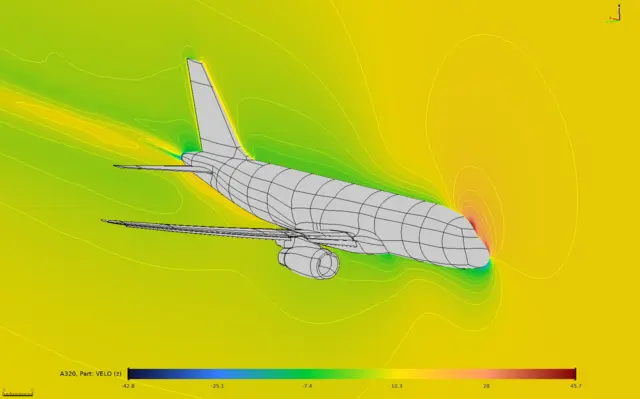
We have participated in several AIAA Drag Prediction Workshops. Following DPW4, we computed drag polars on the shared multi-block grids and processed the results with the far-field drag extraction tool developed with RUAG.
AIAA Drag Prediction WorkshopStatic and dynamic stability
We routinely perform steady CFD simulations to assess static stability and unsteady simulations to determine how aircraft and re-entry vehicles damp oscillations after a disturbance.
Turbulent flow analysis
Advanced turbulence modelling and spectral analysis capture wake dynamics, separation, and transition phenomena relevant to performance and noise.
Subsonic to low-supersonic flow analysis
This device is using the lightweight preview.
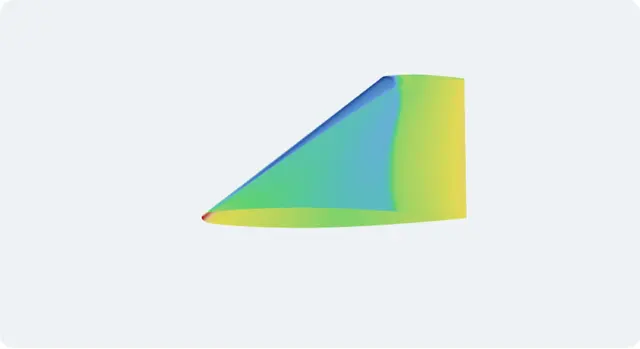
We perform RANS and DES simulations across subsonic to low-supersonic regimes with high-quality mesh generation, boundary-layer resolution, and careful boundary-condition treatment.
Active flow control
We use Zero Net Mass Flux pulsed-air devices and advanced CFD to manipulate difficult vortical flows. Multi-objective optimization identifies device locations and operating parameters for drag reduction, lift augmentation, and noise mitigation.