2026 · Giacomo Benedetti
ATLAS: AI-enabled Tool for Launch and Space Vehicles Design
Future Space Transportation: FLPP Autumn Session 2026.
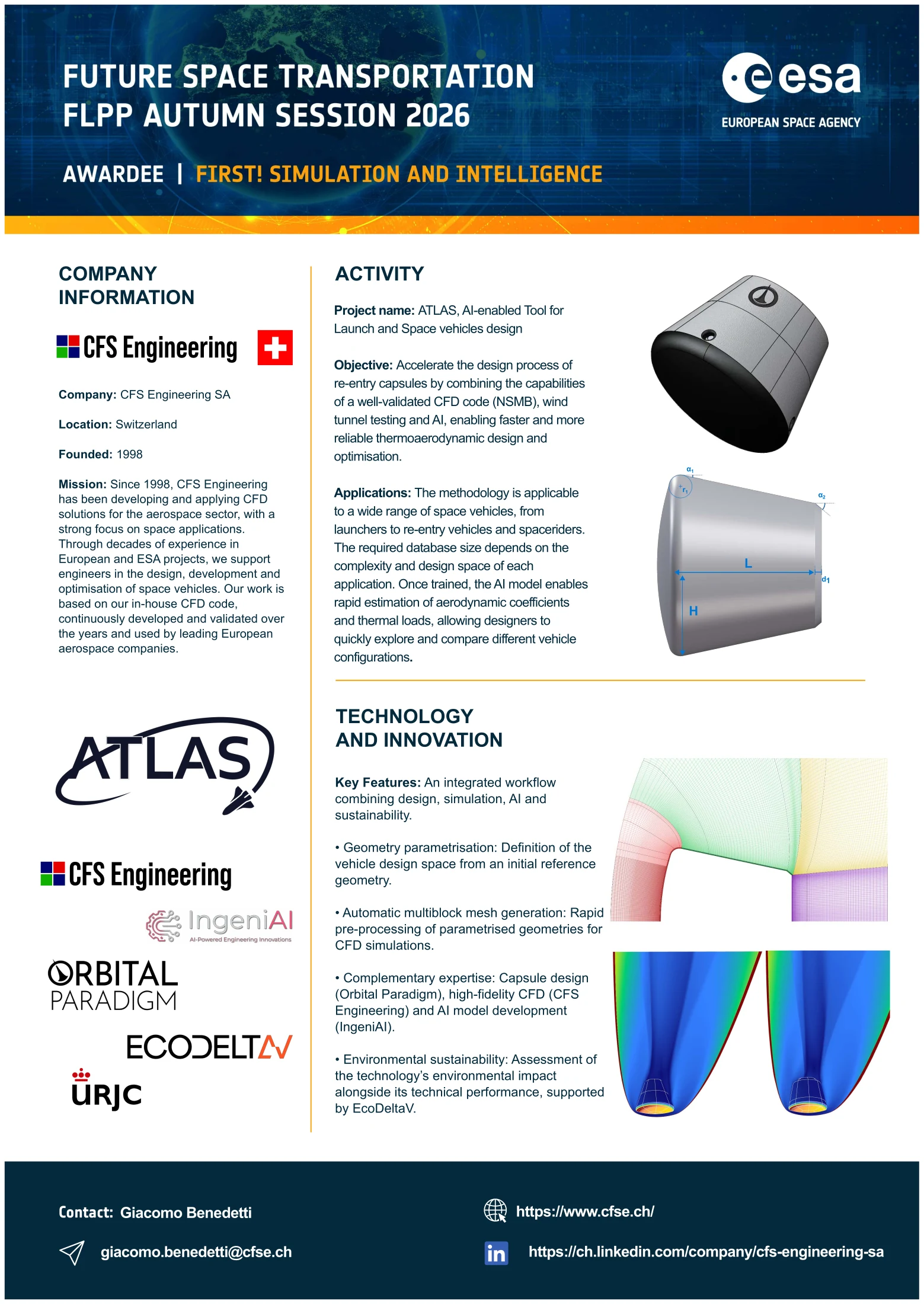
Objective
ATLAS aims to accelerate re-entry capsule design by combining a well-validated CFD code (NSMB), wind-tunnel testing, and AI for faster and more reliable thermoaerodynamic design and optimisation.
Applications
The methodology applies to space vehicles ranging from launchers to re-entry vehicles and spaceriders. The required database size depends on the complexity and design space of each application. Once trained, the AI model rapidly estimates aerodynamic coefficients and thermal loads so designers can explore and compare vehicle configurations.
Technology and innovation
The integrated workflow combines design, simulation, AI, and sustainability. Geometry parametrisation defines the vehicle design space from an initial reference geometry. Automatic multiblock mesh generation rapidly prepares parametrised geometries for CFD simulations.
The work combines capsule design by Orbital Paradigm, high-fidelity CFD by CFS Engineering, and AI model development by IngeniAI. EcoDeltaV supports assessment of environmental impact alongside technical performance.
CFS Engineering
CFS Engineering SA is based in Switzerland and was founded in 1998. It develops and applies CFD solutions for the aerospace sector, with a strong focus on space applications. Its in-house CFD code has been developed and validated through European and ESA projects and is used by European aerospace companies.